$20.00
We will hold your cart for 15:00.
Every runner eventually hits the same wall: pockets. Once you're out past 45 minutes, you're juggling a phone, keys, gels, and water, and none of it fits in a pair of running shorts. The fix falls into three camps — handheld bottles, hydration belts, and minimal running belts — and choosing wrong is one of the most common (and most avoidable) gear mistakes we see.
This guide is written the way we'd advise a customer in person. No spec dumps, no pretending one option wins for everyone. Instead, we'll walk through what each system is genuinely good at, where it fails, and match specific gear to real-world scenarios: marathon training, hot-weather long runs, dark early-morning miles, and runners who just want their phone out of their hand.
Now the reasoning behind those calls.
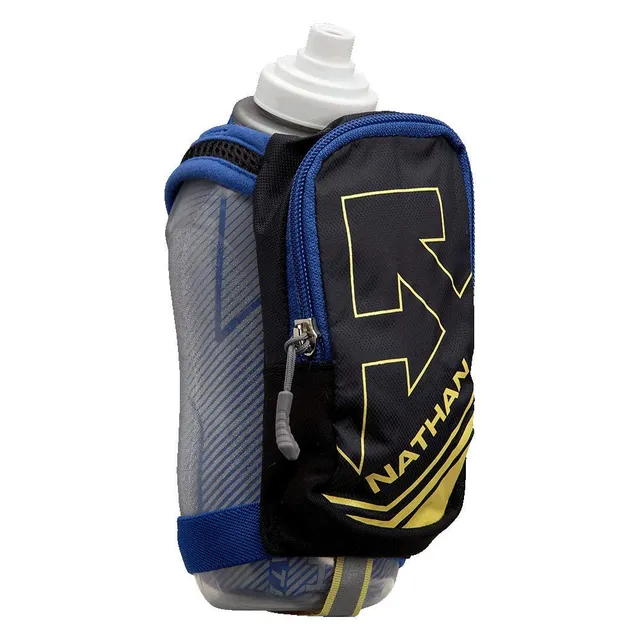
A handheld is exactly what it sounds like: a soft-sided bottle strapped to your hand. Its advantages are hard to beat. You drink without breaking stride, you know instantly how much you've had, there's nothing to bounce around your waist, and cleaning takes seconds. For hot-weather training, that instant access genuinely changes how much you drink — most runners under-hydrate when water is stashed in a pack or belt.
The tradeoffs: one hand is occupied (though good straps minimize gripping), and capacity caps out around 12–18oz before the bottle becomes a weight you're lopsidedly carrying.
The Nathan SpeedDraw Plus Insulated 18oz is the one we recommend most often. The double-wall insulation keeps water noticeably cooler on summer miles, the no-grip hand strap means you're carrying it with a relaxed hand rather than a clenched fist, and the zippered pocket takes a phone plus a gel. At 4.4 stars across more than 1,500 reviews, it's a proven workhorse. If a cap or valve ever wears out, Nathan sells replacement parts — a small thing that extends the life of the bottle considerably.
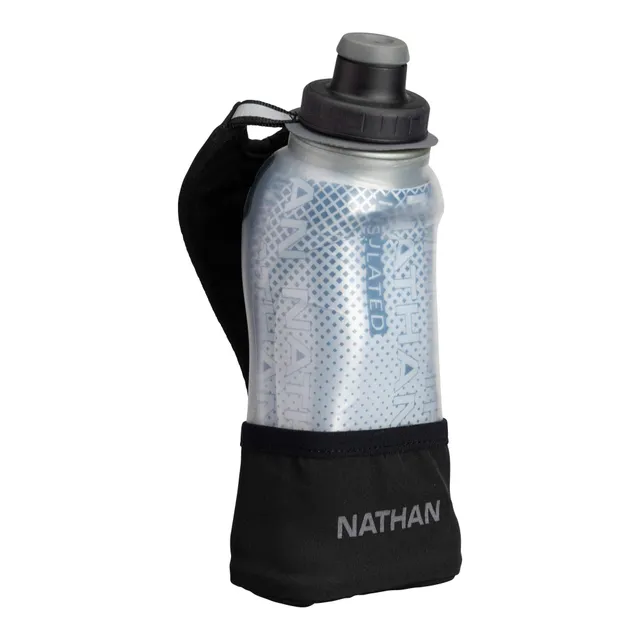
For shorter efforts or runners who find 18oz front-heavy, the Nathan Quick Squeeze Lite 12oz is the lighter call. The adjustable strap is easy to dial in one-handed mid-run, and the push-pull Blast Valve gives a surprisingly fast flow for a small bottle. It's also the easier one to stash in a race-drop bag or carry as a backup.
A hydration belt splits the difference between a handheld and a full vest. You get a flask (or two) mounted at your hip, plus a stretch zippered pocket for phone, fuel, and keys — and both hands stay completely free.
When does a belt beat a handheld? Three situations:
The Nathan Peak Hydration Belt is the best execution of this idea in the current lineup. It ships with an 18oz Speed Draw flask in an insulated, angled holster — the angle matters more than people expect, because you can pull the flask and re-seat it without breaking rhythm or looking down. The expandable stretch pocket swallows a large phone with room left for fuel. The push/pull race cap is quick to sip from, and the whole flask assembly pops out for cleaning, which is how you keep it from getting funky. It averages 4 stars over nearly 1,400 reviews, and the pattern in feedback is consistent: runners who take ten minutes to adjust the belt properly love it; runners who cinch it once and go get bounce. Take the fitting seriously — ride it on your hips, not your waist, and snug it after the first mile.
Not every run needs hydration. If you're doing 30–60 minutes, or you're racing a marathon with aid stations every couple of miles, the actual problem is smaller: where do the phone, keys, and a gel go? That's the niche SPIbelt has owned for years, and it's a genuinely different product category from a hydration belt.
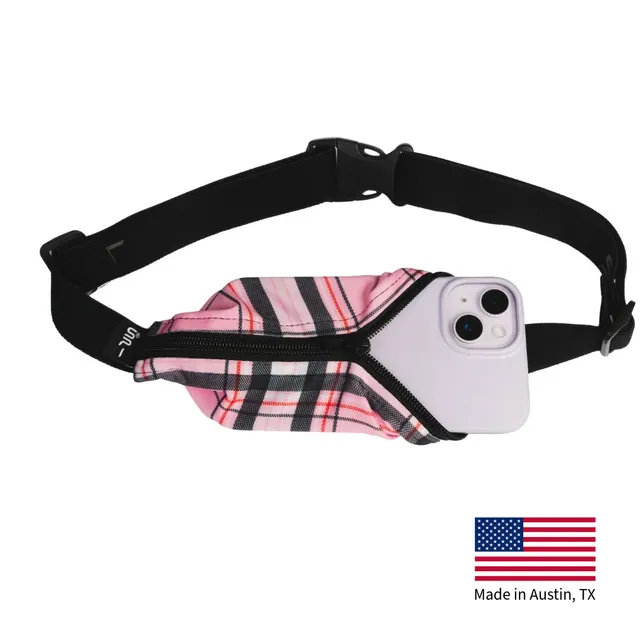
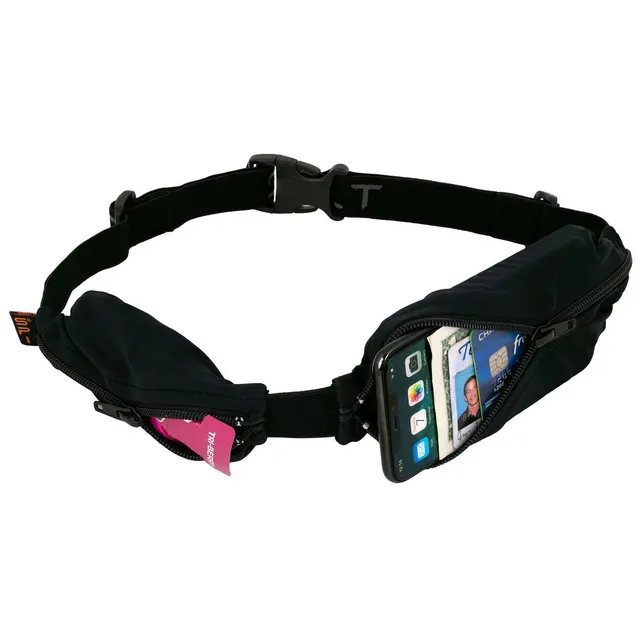
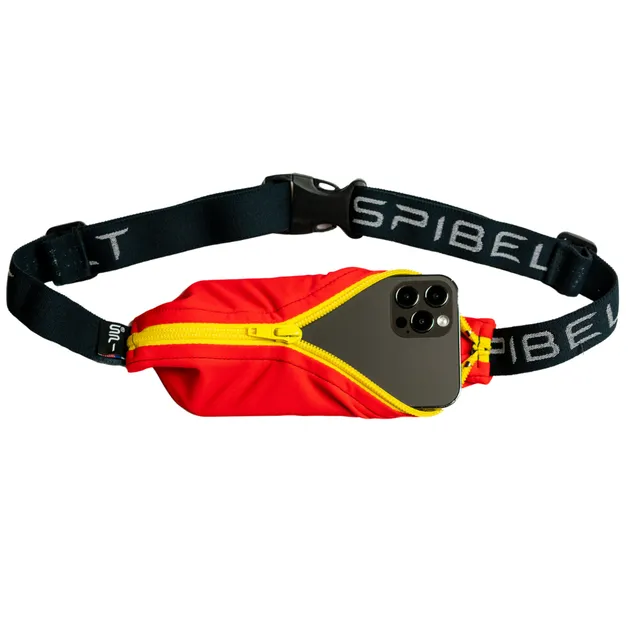
The SPIbelt Original is the classic for a reason: a low-profile, expandable pocket that stretches to fit a large phone and keys, then compresses flat against your body so nothing bounces. It's sewn in Austin, comes in colors you won't be embarrassed to wear post-run, and at $25.91 it's the cheapest way to make pockets a non-issue. If you carry a big phone plus a wallet or medical supplies, step up to the SPIbelt Dual Pocket — two separate pockets mean your phone stops clanking against your keys, and there's enough room for a gel or asthma inhaler alongside everything else.
If any part of your week happens before sunrise or after dark, we'd push you one step further: the SPIbelt Reflective Elastic. It's functionally the same expandable belt, but the elastic itself is high-visibility, so the reflectivity moves with you at hip level — a spot drivers actually look at. You get carry and visibility in one piece of gear instead of layering a separate reflective vest over a separate belt. For early-morning runners, it's the single best two-birds-one-stone purchase on this page.
| Your run | Best pick | Why |
|---|---|---|
| Under 60 minutes, neighborhood miles | SPIbelt Original | Phone and keys secured, zero water needed |
| Marathon training with frequent water stops | SPIbelt Dual Pocket or Reflective | Aid stations handle water; you handle fuel and phone |
| Hot-weather long runs | Nathan SpeedDraw Plus 18oz | Insulated, instant sipping, visible water level |
| Trail runs, both hands wanted | Nathan Peak Belt | Water and phone on the hips, hands free for balance |
| Pre-dawn or evening running | SPIbelt Reflective Elastic | Carry plus 360° visibility in one belt |
| Minimalist racer | Nathan Quick Squeeze Lite 12oz | Light, quick-grab, stashable |
1. Buying capacity you don't need. A 15L hydration vest for 5K loops is overkill that rides like a backpack. Match the system to your longest typical run, not your aspirational one.
2. Skipping the fit break-in. Belts ride best at the hips, and every belt loosens slightly in the first mile. Snug it, run a mile, re-snug. This one habit eliminates 90% of bounce complaints.
3. Ignoring hygiene. Any bottle you sip from while breathing hard will grow funk if you never clean it. Take flasks out of holsters, rinse after hot runs, and every couple of weeks wash your belt and bottles with something designed for technical gear — Nathan Power Wash is made exactly for this: pH-neutral, non-toxic, and it strips sweat odor out of stretch fabrics and insulation without degrading them.
Two low-cost additions that punch far above their price. First, Nathan Elastic No-Tie Shoe Laces — at $12 with nearly 5,000 reviews averaging 4.5 stars, they turn any running shoe into a slip-on, eliminate mid-run retying, and let you loosen laces instantly when feet swell on long efforts. Installation takes five minutes: swap the laces, thread the tension lock, trim, and clip the ends. Second, if you run in real heat, sun protection is a carry problem too — a lightweight hooded sun shirt like the Mountain Hardwear Crater Lake Hoody gives you UPF 50+ coverage that never sweats off the way sunscreen does, with a hood that fits under a hat or helmet.
Don't think of these as competing products — think of them as a progression. Start with a belt that solves the phone problem, add a handheld when runs stretch past an hour, and graduate to a hydration belt when you want water without giving up your hands. Most experienced runners own two of the three and rotate by season and distance.
Ready to pick? The SpeedDraw Plus 18oz, the Nathan Peak Belt, and the SPIbelt Dual Pocket cover 90% of runners' needs between them. Whichever you choose, buy once, fit it properly, and it'll quietly disappear into your running routine — which is exactly what good carry gear should do.
Orders over $45.00 ship free. Otherwise, shipping is $8.00.
Hassle-free returns
SSL encrypted checkout
100% genuine products
Compare 765 hiking backpacks and trail packs from Big Agnes, Mountain Hardwear, Nathan, and SPIbelt — free shipping over $45.
Email: support@trekhaul.shop
Address: 1427 Ridgeline Trail Suite 208, Boulder, CO 80302, United States